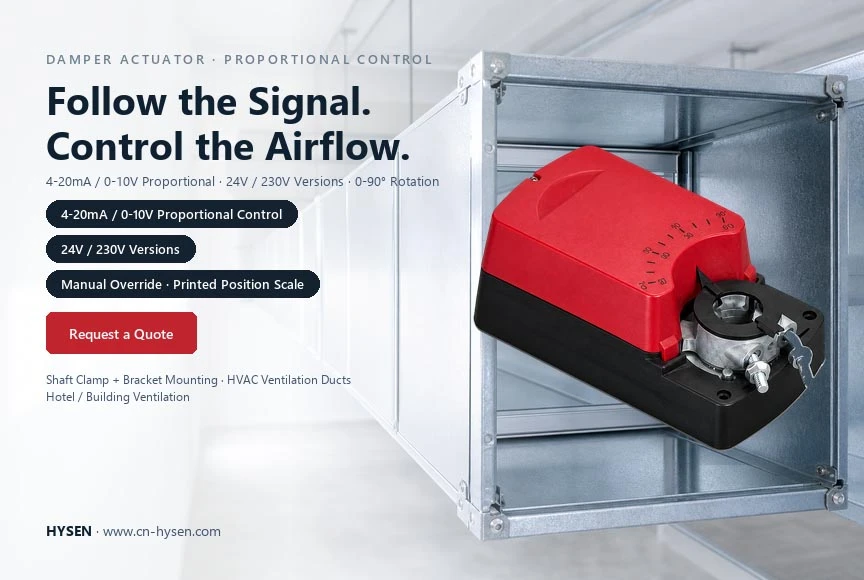
A damper actuator that runs on its own is doing half its job. Connected to a Building Management System (BMS), the same actuator becomes a controllable, observable, diagnosable device - part of a building that manages itself instead of waiting for someone to notice a problem.
But "can it work" depends on a few real conditions: the actuator's control interface, the BMS's available points, and how the two are wired together. This guide explains exactly what makes the pairing work, what to check before you commit, and what you can expect once it's connected.
1. What a BMS Actually Expects From an Actuator
A BMS doesn't care about the actuator's mechanical build - it cares about three things it can exchange over a wire:
| What the BMS needs | What the actuator provides |
|---|---|
| A way to send commands | Position command via analog signal or bus protocol |
| A way to read the result | Position feedback, status, fault flags |
| A way to schedule and alarm | Continuous two-way data after integration |
If the actuator can deliver those three, it can work with a BMS. The good news: virtually every modern damper actuator can.
2. How Actuators and BMS Systems Talk
There are two ways to connect, and both are widely used:
Route A - Analog (simple and universal)
The BMS controller outputs a 0–10 V DC (or 2–10 V) modulating signal to the actuator
The actuator returns a position feedback signal to the controller's analog input
Works with essentially any BMS - no protocol knowledge needed
Best for smaller installations and retrofits with spare analog points
Route B - Bus communication (rich and scalable)
The actuator carries a protocol interface such as BACnet MS/TP or Modbus RTU
The actuator gets its own address on the network and exchanges data directly with the BMS
You read actual position, status, runtime and fault information - not just the command you sent
Best for new builds, larger plants, and anyone who wants live data from every damper
Many modern actuators support both - analog control plus a bus interface for monitoring - which gives you simple control today and full visibility when you're ready.
3. What About Actuators Already Installed?
This is the question behind most "can it work" searches: can I connect my existing dampers to a new BMS?
Usually, yes, in one of three ways:
Existing analog actuators - if your actuator accepts 0–10 V, it can connect directly to the BMS's analog output/input points. No replacement needed.
On/off and floating-point actuators - the BMS can control them through digital (relay) outputs. You get open/close control, though not proportional position.
Add communication - some actuator families offer add-on bus modules or gateways that retrofit a protocol interface onto an analog installation.
The practical rule: if you have spare I/O points and the right signal type, the BMS can talk to it. If you want two-way data on every damper, check whether your actuator supports a bus protocol or a compatible gateway.
4. The Compatibility Checklist
Before wiring anything, run through these five checks:
Control signal - does the actuator accept the BMS's output (0–10 V, on/off, floating, or bus protocol)?
Power supply - is the actuator's voltage (e.g. 24 V AC/DC) available at the damper location?
Feedback - does the actuator provide a feedback signal, or does the BMS need auxiliary switches instead?
Protocol and addressing - for bus versions: does the BMS support the same protocol, and is each actuator addressed correctly?
Point mapping - are the setpoint, feedback and status points defined in the BMS database?
Get these five right and the integration is a wiring job, not a project.
5. What You Actually Gain From the Connection
Once an actuator is on the BMS, it stops being a hidden component:
Central control - command every damper from one screen, or from a phone on the way to site
Energy savings - dampers follow occupancy and demand, not fixed schedules
Real feedback - the BMS sees the actual position, so a stuck damper is an alarm, not a comfort complaint
Scheduling - fresh air, mixing and exhaust dampers follow the building's daily rhythm automatically
Fault detection - position trends reveal wear, drift and linkage problems early
Reporting - prove system performance with logged data instead of assumptions
6. What the BMS Can't Do For You
Worth saying honestly - a BMS connection fixes control and visibility, not physical problems:
It can't overcome wrong torque - an under-powered actuator will still stall, it will just tell you about it
It can't replace fail-safe hardware - spring return is a mechanical safety function; the BMS can only complement it
It can't fix bad wiring - a poor connection shows up as noise, drift and mystery faults
Think of the BMS as the actuator's eyes and hands in the control room - the actuator still needs to be correctly sized and properly installed in the first place.
7. Common Questions, Straight Answers
"Does every damper actuator need a BMS?" No - standalone operation is fine for simple or small installations. Integration pays off when you have multiple dampers, energy goals, or remote monitoring needs.
"Is analog or BACnet/Modbus better?" Both work. Analog is simpler and universal; bus communication gives more data and scales better. Many projects use analog for control and add monitoring where it matters most.
"Can I mix actuator types on one BMS?" Yes - a BMS is built for mixed points. Analog, on/off and bus actuators can coexist as long as each matches its own wiring and point definition.
"Is it expensive to integrate?" Usually not. The actuator itself is the main cost; integration is wiring plus point configuration. With bus versions, cabling is often less than a full analog installation.
8. The Short Version
Yes, damper actuators work with BMS systems - via analog signals or bus protocols
Check five things first: signal, power, feedback, protocol, point mapping
Existing actuators can often be connected without replacement
Integration pays back in energy, visibility, alarms and scheduling
The BMS complements, not replaces - size and install the actuator correctly first
Ready to Connect Your Dampers to the BMS?
Whether you're retrofitting an existing plant or commissioning a new building, the right actuator makes BMS integration straightforward. Our HVAC damper actuator range offers analog and bus communication options - including BACnet and Modbus - with the torque, fail-safe and voltage variants your system needs. [Contact us] with your project details and we'll help you specify actuators that talk to your BMS from day one.