1. What an Actuator Actually Does
An actuator is a device that converts a control signal into mechanical motion. In a valve system, that motion does one of two jobs:
Open the valve - lift the stem or rotate the disc to let media flow through.
Close the valve - return to seat the stem or disc and stop the flow.
Regardless of technology, every actuator follows the same core logic:
Control signal → Energy conversion → Mechanical transmission → Valve movement
The differences between actuator types come down to one thing: what energy source does the conversion, and how the mechanical force is produced.
2. Driving Principle #1: Thermal Expansion (Electric Thermal Actuators)
The electric thermal actuator - also called a thermoactuator - is the most common drive in underfloor heating and radiator systems. It does not use a motor at all.
How it drives the valve:
The thermostat sends power to the actuator's built-in PTC heating element.
The heat melts and expands a temperature-sensitive wax element inside the housing.
The expanding wax pushes a piston downward with strong, steady force.
The piston presses the valve stem and opens the valve.
When the thermostat cuts power, the wax cools and contracts.
A return spring pulls the stem back and closes the valve.
Why it is so widely used:
Noiseless - no motor, no gears, no hum. Ideal for bedrooms and hotels.
Low power - only about 2W per actuator, consumed only while operating.
Maintenance-free - very few moving parts, nothing to wear out.
Fail-safe - Normally-Closed (NC) units close automatically on power loss, preventing uncontrolled flow.
Simple wiring - standard 2-wire connection, one actuator per heating loop.
3. Driving Principle #2: Electric Motor + Gear Reduction (Motorized Valves)
When a valve needs rotary motion, higher force, or precise positioning, a motorized actuator is used. This is the driving principle behind motorized ball valves, butterfly valves, and many two-way/three-way water valves.
How it drives the valve:
A synchronous electric motor receives power and begins to rotate.
A gear reduction train steps down the motor speed while multiplying torque.
The reduced rotation turns the valve stem - typically a 90° quarter-turn for ball and butterfly valves.
Cam discs and limit switches detect the open/closed position and cut the motor power automatically.
Reversing the drive direction (or a spring return in fail-safe models) rotates the valve back to close.
Why it is used:
High torque - gear reduction multiplies motor force to overcome valve seat pressure.
Precise positioning - can hold intermediate openings for flow regulation, not just full open/close.
Wide range - available from small HVAC valves up to large industrial multi-turn valves.
Controllable speed - slower, controlled closing reduces water hammer risk.
4. Driving Principle #3: Electromagnetic (Solenoid Actuators)
A solenoid actuator drives the valve with an electromagnetic field rather than heat or rotation.
How it works: When current flows through the coil, it creates a magnetic field that pulls an internal plunger, opening or closing the valve directly. When power is removed, a spring or gravity returns the plunger.
Best suited for: small valves, low-pressure lines, and applications needing fast on/off response. Solenoids are compact and quick, but they are not designed for large valves or high-pressure seating force.
5. Driving Principle #4: Pneumatic (Air-Driven Actuators)
Pneumatic actuators use compressed air as the driving force. Air pressure acts on a piston or diaphragm to generate linear thrust or rotary torque.
How it works: A control valve admits compressed air into the actuator chamber; the air pushes a piston, which turns a rack-and-pinion or scotch-yoke mechanism to open the valve. A spring return closes it when air is released.
Best suited for: industrial process plants, chemical and gas lines, and explosion-proof environments. Pneumatic actuators are fast and inherently safe, but they require an air supply system - which is why they are rarely used in residential hydronic heating.
6. Choosing the Right Driving Principle
| Drive type | Energy | Motion | Speed | Typical use | Trade-off |
|---|---|---|---|---|---|
| Thermal expansion (wax) | Electric heat | Linear | Slow & gentle | Underfloor heating loops, radiators | Low power, silent, but no intermediate position |
| Motorized (motor + gear) | Electric motor | Rotary / linear | Controlled | Ball valves, two/three-way water valves | High torque and precision, more parts |
| Solenoid (electromagnetic) | Magnetic field | Linear | Very fast | Small on/off valves | Compact and fast, limited force |
| Pneumatic (air) | Compressed air | Linear / rotary | Fast | Industrial process valves | Explosion-proof, needs air supply |
For residential and commercial hydronic heating, the two principles that matter most are thermal expansion for per-loop manifold control and motorized drive for larger, rotary-motion valves.
7. Hysen Actuators: Thermal Expansion and Motorized Driving in Practice
At Hysen, we manufacture both main driving types for heating systems, factory-direct with OEM/ODM support.
Electric thermal actuators (wax-driven):
H30-9 electric thermal actuator - wax-filled element driven by PTC heating, spring return, noiseless and maintenance-free. AC230V (DC24V available), 2W, 110N force, 3mm stroke, M30×1.5 mounting.
HY30-6 underfloor heating valve actuator - AC230V/24V, only 2VA dissipation while opening or closing, controls the valve from the thermostat signal loop by loop.
Motorized valves (motor-driven):
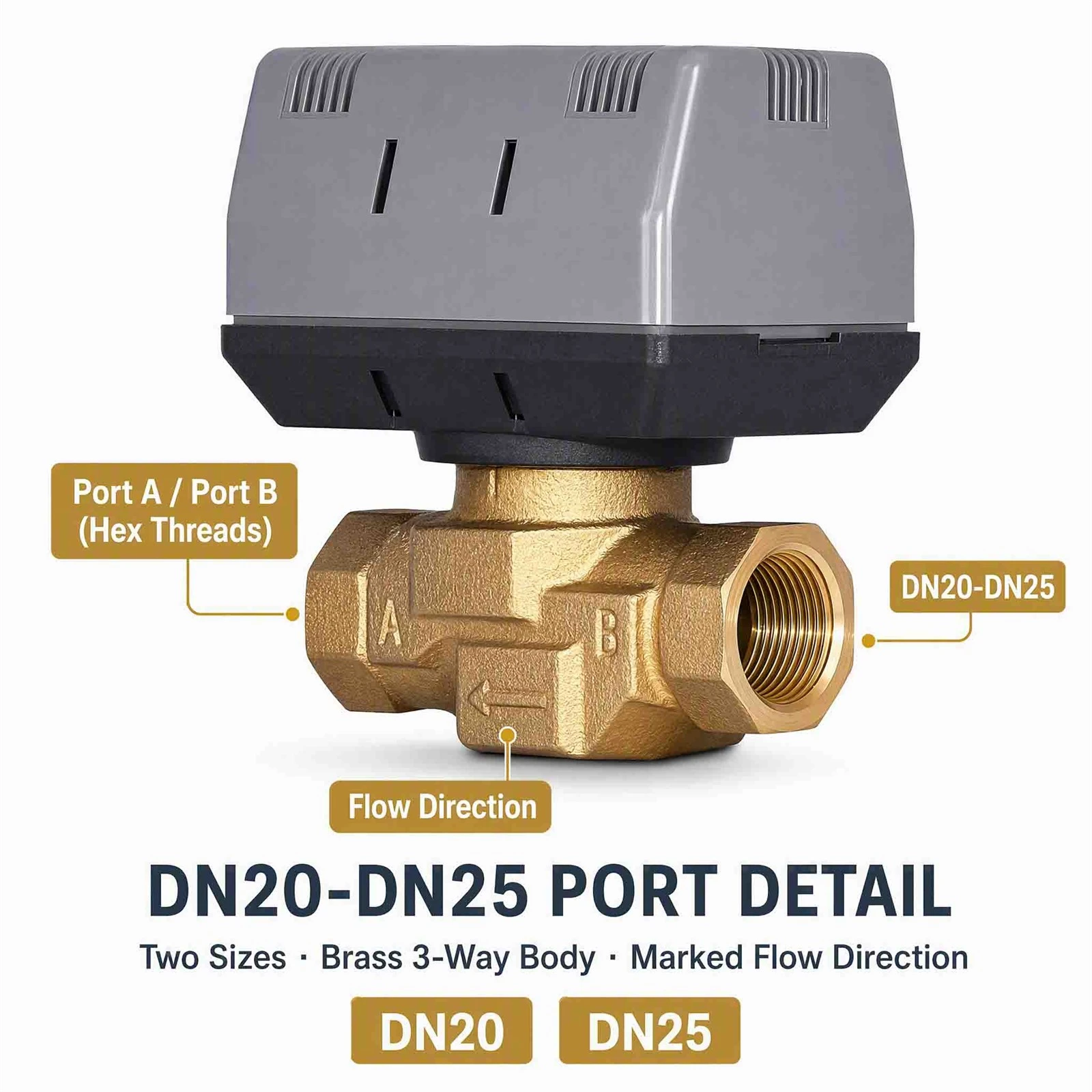
HY4016 motorized water valve - available in 2-way and 3-way configurations, ideal for fan coil units and motorized water valve systems.
Both driving principles are engineered in-house, tested for reliability, and certified for the European market.
8. The Takeaway
The driving principle of an actuator decides its performance, its cost, and its best application. Thermal expansion delivers the quiet, low-power, fail-safe control that underfloor heating demands; motorized drive delivers the torque and precision that rotary valves need. Matching the principle to the valve is the key to a heating system that installs fast and works for years.
If you are selecting actuators or motorized valves for your heating project, the Hysen team can help you match the right driving principle to your manifold, valve, and control system.
Contact Hysen today for samples, specifications, and a customized valve-control solution.