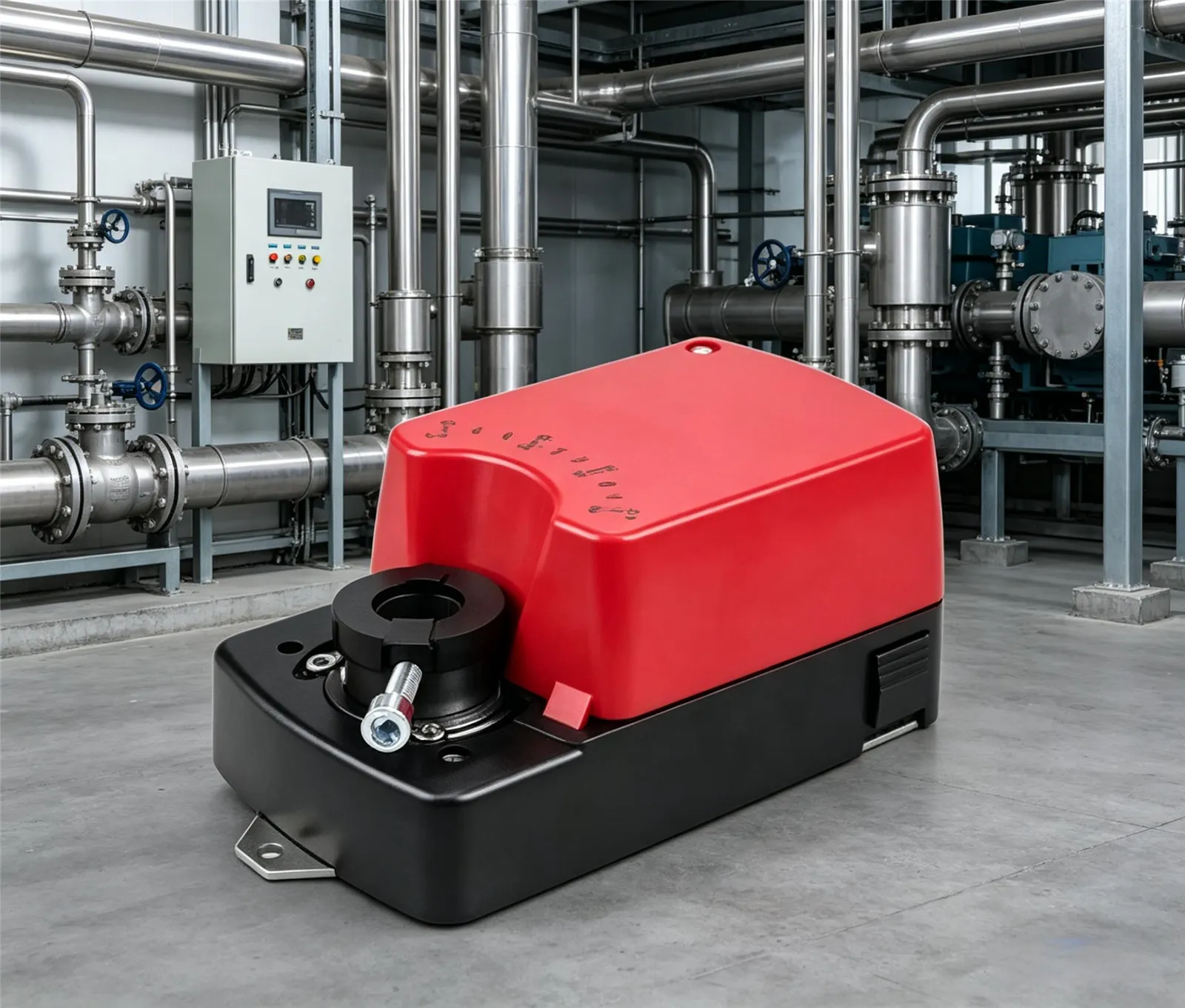
In industrial automation, HVAC systems, water treatment and pipeline engineering, valve actuators play an irreplaceable role as the core bridge between intelligent control and physical valve operation. The most essential function of a valve actuator is to accurately convert standard electric control signals into stable rotary or linear mechanical motion, realizing automatic opening, closing and precise throttling of various valves. Understanding this conversion principle helps engineers, purchasers and system integrators select the right actuator for project matching and long-term stable operation.
The whole conversion process follows a clear logical flow: electric signal reception → intelligent signal processing → electric energy driving → mechanical transmission → output motion execution + position feedback.
First, the valve actuator receives external electric signals sent by PLC, DCS, thermostat or industrial control system. These signals are mainly divided into digital on/off signals and analog regulation signals like 4-20mA or 0-10V. Each signal carries clear commands: fully open, fully closed, or stay at a specific opening percentage. The built-in control board of the actuator acts as the brain, decoding and analyzing the received electric signal instantly and issuing accurate operation instructions to the drive component.
Next comes energy conversion by the core power unit-the electric motor. According to electromagnetic induction principle, the motor converts electrical energy into high-speed rotational mechanical energy. Direct high-speed rotation cannot drive heavy industrial valves, so a precision gearbox and worm gear transmission system work to reduce speed and amplify torque. It lowers the motor's fast rotation speed and outputs high-torque power that valves need to overcome medium pressure and mechanical friction.
Then the transmission mechanism converts the rotational motion into applicable mechanical motion for different valves. For ball valves, butterfly valves and plug valves, the actuator outputs rotary motion to drive the valve stem to rotate. For globe valves, gate valves and diaphragm valves, the lead screw and nut structure further convert rotary motion into linear up-and-down push-pull motion to adjust valve flow accurately.
To ensure control accuracy and operational safety, modern valve actuators are equipped with position sensors and torque feedback modules. They real-time monitor the valve's opening position and operating torque, feed back data to the control system through electric signals, and form a closed-loop control. Once reaching the set limit position or over-torque status, the actuator automatically cuts off power to stop movement, avoiding equipment damage and ensuring system safety.
Compared with pneumatic and hydraulic actuators, electric valve actuators feature simple signal conversion, easy wiring, precise positioning, low maintenance cost and no need for air source or hydraulic station. They are widely adopted in commercial buildings, industrial workshops, central air conditioning HVAC, water supply and drainage, petrochemical and new energy industries.
If you are looking for high stability, high precision and cost-effective electric valve actuators that support standard electric signal input and reliable mechanical motion output, our series of actuators meet CE and RoHS certification, with complete specifications and customizable control modes for various valve matching and automation system renovation projects.
#Tags#ValveActuator #ElectricActuator #HVACControls #IndustrialAutomation #SignalToMotion #ValveControlSystem