

Damper Actuator For HVAC Systems
Author: [2026-09-06] | By Xiamen Hysen Control Technology Co., Ltd. Sally Chen sally@cn-hysen.com
A damper actuator for HVAC systems converts an electrical, pneumatic, or manual control command into mechanical movement at the damper shaft. In practical terms, the actuator determines whether a damper is fully open, fully closed, or positioned at an intermediate angle to control airflow through a duct.
For commercial HVAC, VAV, building automation, smoke-control, and industrial ventilation systems, actuator selection should be based on control mode, shaft torque, power supply, fail position, operating environment, and installation method-not simply the physical size of the damper.
Contents
- What Is a Damper Actuator for HVAC Systems?
- What Does an HVAC Damper Actuator Do?
- Main Types of HVAC Damper Actuators
- How to Select the Correct Damper Actuator
- Electric vs Pneumatic vs Manual Actuators
- On-Off vs Modulating Damper Actuators
- Spring Return and Fail-Safe Operation
- Fire and Smoke Damper Actuators
- Explosion-Proof Damper Actuators for Hazardous Areas
- Hysen HVAC Damper Actuator Product Range
- Why Actuator Torque Matters
- Hysen Manufacturing and ODM/OEM Capability
- Applications
- FAQ
- Request an HVAC Actuator Solution
1. What Is a Damper Actuator for HVAC Systems?
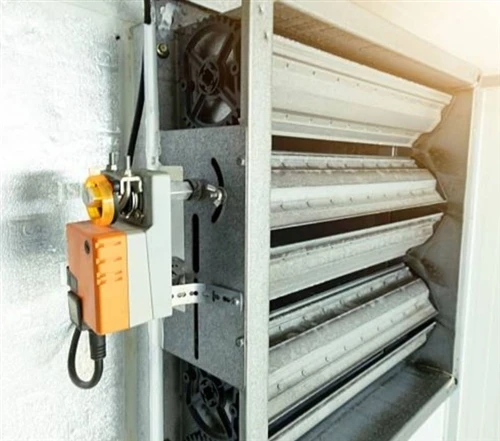
An HVAC damper actuator is the drive unit installed on a damper to control the position of its blades. The actuator receives a command from a thermostat, HVAC controller, BMS, PLC, fire alarm system, or other control device and produces rotary or linear mechanical movement.
The actuator can be installed directly on the damper shaft or connected through a mechanical linkage. Depending on the model, the control command may produce two-position movement or continuous positioning between approximately 0% and 100%.
For system designers and purchasing teams, the actuator is not an isolated component. Its torque, control input, return mechanism, environmental rating, shaft compatibility, and mounting arrangement must match the damper and the HVAC control architecture.
Key actuator selection variables under CE, UL and HVAC control requirements
| Parameter | Typical Engineering Question | Why It Matters |
|---|---|---|
| Supply voltage | 24 VAC/DC, 110 VAC, 220 VAC or other? | Must match the control panel and power supply |
| Control mode | On-off, floating or modulating? | Determines actuator and controller compatibility |
| Control signal | 0-10 V, 2-10 V, 4-20 mA, dry contact, etc. | Determines how damper position is commanded |
| Torque | How much shaft torque is required? | Prevents incomplete or unstable damper movement |
| Return function | Spring return or non-spring return? | Determines behavior after power loss |
| Rotation | Required operating angle? | Must correspond with damper blade travel |
| Environment | Indoor, outdoor, dusty, humid or hazardous? | Determines enclosure and protection requirements |
| Feedback | Auxiliary switch or position feedback? | Allows BMS or control equipment to verify damper status |
2. What Does an HVAC Damper Actuator Do?
The basic job of an HVAC damper actuator is to regulate airflow. Its mechanical output changes the damper blade position, which changes the effective air passage area inside the duct.
In a zoned HVAC system, this allows different rooms or areas to receive different amounts of conditioned air. In a VAV system, a modulating actuator can continuously adjust the damper position according to the control signal.
Typical operating sequences include:
- On-off control: Drive the damper to the fully open or fully closed position.
- Floating control: Use separate open and close commands to position the damper.
- Modulating control: Continuously position the damper according to an analog signal.
- Fail-safe operation: Return the damper to a defined position after power interruption.
- System interlock: Use auxiliary contacts or feedback to coordinate fans, AHUs and other equipment.
A correctly selected actuator can therefore influence airflow distribution, zone temperature control, ventilation performance and overall HVAC operating efficiency.
0-10 V modulating control under typical BAS architectures
A common modulating arrangement uses a 0-10 V DC command:
| Control Signal | Typical Command Position | System Function |
|---|---|---|
| 0 V DC | Minimum/closed position | Minimum airflow or shut-off |
| 2 V DC | Low opening | Low airflow |
| 5 V DC | Mid-range position | Intermediate airflow |
| 8 V DC | High opening | High airflow |
| 10 V DC | Maximum/open position | Maximum airflow |
The exact signal-to-position relationship depends on the actuator and controller configuration. Commissioning should verify the actual direction of rotation and end positions rather than assuming that every actuator uses identical signal logic.
Request an HVAC Actuator Solution
3. Main Types of HVAC Damper Actuators
HVAC damper actuators can be classified by power source, control method, return function and application environment. For procurement, these categories are more useful than selecting a model solely by appearance.
3.1 Electric Damper Actuators for CE-LVD and HVAC Automation
Electric damper actuators are the most common choice for modern commercial HVAC control systems. An electric motor drives the damper shaft directly or through a reduction mechanism.
Typical advantages include:
- Compatibility with electronic HVAC controllers
- Fast electrical response
- Low installation complexity compared with pneumatic systems
- Support for on-off and modulating control
- Integration with BAS and building automation systems
- Availability of spring-return and non-spring-return configurations
Electric actuators can be specified for different supply voltages and control signals according to the project architecture.
Hysen focuses on electric HVAC damper actuators for applications ranging from standard ventilation to VAV and emergency smoke-control systems.
3.2 Pneumatic Damper Actuators for Industrial HVAC
Pneumatic actuators use compressed air to generate mechanical movement. A pneumatic actuator generally produces linear movement that is converted into damper shaft rotation through a linkage.
They can be useful in environments where electrical equipment presents additional ignition concerns or where a centralized instrument-air system already exists.
However, pneumatic control requires:
- Clean and dry compressed air
- Air compressors or an existing instrument-air network
- Tubing and pneumatic control components
- Additional installation and maintenance infrastructure
For standard commercial buildings without an existing compressed-air system, an electric actuator is normally simpler to deploy.
3.3 Manual Damper Actuators for Basic Air Balancing
Manual damper controls use a handle, lever or locking mechanism rather than an automatic drive motor.
They can be suitable when a damper is adjusted only during commissioning or seasonal balancing. They do not provide automatic response to thermostat or BMS commands and therefore are not suitable for dynamic zone control.
4. How to Select the Correct Damper Actuator
Actuator selection starts with the damper rather than the actuator catalogue.
The engineering sequence should normally be:
Damper specification → required torque → control mode → power supply → fail position → environment → shaft/mounting → accessories
4.1 Torque sizing under actual airflow conditions
The actuator must generate enough torque to overcome the mechanical resistance of the damper.
The required torque is affected by:
- Damper blade area
- Air velocity
- Static pressure
- Blade and jamb seals
- Damper construction
- Bearing friction
- Shaft condition
- Installation alignment
- Required fail-open or fail-closed operation
Low-leakage dampers can require greater actuator torque because seals increase mechanical resistance.
A practical specification should therefore include the damper manufacturer's required operating torque rather than relying only on damper dimensions.
4.2 Damper actuator sizing by application conditions
| Application | Control Requirement | Typical Actuator Consideration |
|---|---|---|
| Fresh-air damper | Open/close or modulating | Control signal and airflow range |
| Return-air damper | Modulating | Position accuracy and feedback |
| VAV terminal | Continuous positioning | Modulating signal and torque |
| Zone damper | Automatic control | Compact mounting and low power |
| Smoke damper | Emergency positioning | Fail-safe and applicable fire standard |
| Industrial ventilation | Harsh environment | Enclosure and environmental rating |
| Hazardous area | Explosion protection | Certified hazardous-area construction |
Do not select an actuator only because its nominal torque appears higher than the damper requirement. The actual installation, shaft arrangement and safety mode must also be checked.
5. Electric vs Pneumatic vs Manual Actuators Under HVAC Control Requirements
| Feature | Electric Actuator | Pneumatic Actuator | Manual Control |
|---|---|---|---|
| Power source | Electrical | Compressed air | None |
| BAS integration | Excellent | Possible with additional components | No |
| Modulating control | Available | Available with positioner | No |
| Installation | Electrical wiring | Air piping + linkage | Simple |
| Fail-safe option | Spring return | Inherently available through spring action | Manual |
| Maintenance | Low | Air-system maintenance required | Low |
| Typical application | Commercial HVAC, VAV, BAS | Industrial HVAC, special environments | Balancing and fixed settings |
| Automation | High | High | None |
For most modern HVAC automation projects, electric damper actuators provide the most direct connection between the building control system and the mechanical damper.
6. On-Off vs Modulating Damper Actuators Under BAS Control
The required control strategy should be defined before the actuator model is selected.
6.1 On-Off Damper Actuators
An on-off actuator has two primary operating positions:
- Open → airflow permitted
- Closed → airflow restricted or blocked
This arrangement is appropriate where intermediate damper positioning is not required.
Common applications include:
- Fresh-air isolation
- Exhaust control
- Equipment interlock
- Basic ventilation control
- Certain smoke-control applications
6.2 Modulating Damper Actuators
A modulating actuator can position the damper across its operating range according to a control signal.
A BAS, PLC, room controller or other HVAC controller can adjust the damper continuously to match airflow demand.
For example, in a meeting room with changing occupancy, the controller can increase outdoor-air or supply-air flow as the demand increases instead of operating the damper only at 0% or 100%.
Typical HVAC control signal comparison
| Signal | Signal Type | Typical Use |
|---|---|---|
| 0-10 V DC | Analog voltage | HVAC modulating control |
| 2-10 V DC | Analog voltage | Position-proportional control |
| 4-20 mA | Analog current | Industrial/BAS control |
| Dry contact | Switching contact | Basic open/close command |
| Floating/SPDT | Open/close commands | Three-point floating control |
The actuator input must match the controller output. A 0-10 V controller should not be connected to an actuator configured only for dry-contact switching.
7. Spring Return and Fail-Safe Operation Under Power-Loss Conditions
A spring-return damper actuator contains a mechanical spring that stores energy while the motor moves the actuator.
When electrical power is removed, the stored spring energy drives the actuator toward its defined fail position.
This is different from a non-spring-return actuator, which normally remains in its last position after power is interrupted.
-
Spring-return operating sequence
- Normal power → motor drives damper
- Power failure → spring releases stored energy
- Actuator returns → predetermined damper safety position
The fail position can be specified as fail open or fail closed, depending on the ventilation and safety design.
Engineers should distinguish between:
- Normal operating position
- Fail-open position
- Fail-closed position
These terms describe different operating conditions and should be clearly stated in project documentation.
Spring return vs non-spring return
| Characteristic | Spring Return | Non-Spring Return |
|---|---|---|
| Power failure response | Returns to defined position | Normally stays in last position |
| Safety application | Suitable where fail position is required | Suitable where position retention is acceptable |
| Mechanical spring | Yes | No |
| Typical use | Emergency ventilation, smoke control, critical air handling | Standard zone and VAV control |
| Motor load | Must overcome spring force | No spring-return load |
8. Fire and Smoke Damper Actuators Under UL and NFPA Requirements
Fire and smoke control applications impose different requirements from ordinary comfort-air HVAC.
A fire and smoke damper actuator may be required to move the damper to a defined position when triggered by a fire alarm, smoke detection system, temperature device or other safety control.
Important engineering parameters include:
- Rated operating torque
- Spring-return capability
- Fail position
- Response time
- Damper shaft compatibility
- Temperature resistance
- Electrical protection
- Applicable fire and smoke damper certification
For safety-rated assemblies, actuator selection should be made together with the damper manufacturer and the applicable project standards. Factory installation can reduce field coordination errors because the damper and actuator can be tested as an assembly before shipment.
Project specifications may reference standards such as UL 555S, NFPA requirements, or regional equivalents. The applicable certification must always be verified against the exact actuator-damper combination and project jurisdiction.
9. Explosion-Proof Damper Actuators for Hazardous Areas
Explosion-proof damper actuators are designed for ventilation systems installed in environments where flammable gases, vapors or combustible dust may be present.
Typical application sectors include:
- Petrochemical facilities
- Gas processing plants
- Pharmaceutical production
- Chemical plants
- Industrial ventilation
- Hazardous storage areas
The actuator enclosure and electrical construction must prevent internal ignition sources from creating an ignition hazard outside the equipment.
According to the supplied Hysen product specifications, Hysen explosion-proof actuator series are designed for ratings including Ex db IIB T6 Gb / Ex tb IIIC T85°C Db or higher.
For an actual project, the required Ex classification must be checked against the hazardous-area classification, gas/dust group, temperature class, installation zone and applicable certification documentation.
10. Hysen HVAC Damper Actuator Product Range
Hysen provides multiple damper actuator configurations for different HVAC control and ventilation requirements.
Hysen actuator categories
| Product Category | Main Function | Typical Application |
|---|---|---|
| Standard damper actuator | Automatic damper positioning | Commercial HVAC |
| Fast-response actuator | Rapid damper movement | Air handling and ventilation |
| Spring-return actuator | Defined fail position | Safety and critical ventilation |
| Fire/smoke actuator | Emergency damper operation | Fire and smoke-control systems |
| Modulating actuator | Continuous positioning | VAV and BAS |
| On-off actuator | Full open/close control | Isolation and ventilation |
| Explosion-proof actuator | Hazardous-area operation | Petrochemical and industrial HVAC |
The product range allows system integrators and HVAC manufacturers to specify different actuator configurations according to control logic, torque and operating environment.
11. Why Actuator Torque Matters in HVAC Damper Control
Torque is one of the most commonly underestimated parameters when selecting a damper actuator.
A damper that appears mechanically light under no airflow may require substantially more torque when exposed to system pressure, airflow velocity and sealing resistance.
The actuator should therefore be selected using the damper's actual operating torque.
Engineering factors affecting actuator torque
- Damper size: Larger blades generally create greater mechanical load.
- Air velocity: Higher airflow can increase resistance to blade movement.
- Static pressure: Higher differential pressure can increase required torque.
- Seal friction: Low-leakage blade and jamb seals add mechanical resistance.
- Damper construction: Blade geometry and bearing design affect friction.
- Installation quality: A twisted or misaligned damper frame can increase resistance.
- Fail-open operation: The actuator may require additional torque when moving against airflow.
- Temperature: Operating temperature can affect materials, lubricants and seals.
For procurement, the preferred approach is to obtain the damper manufacturer's required torque and then select an actuator with sufficient rated output for the actual operating condition.
12. Hysen Manufacturing and ODM/OEM Capability
Xiamen Hysen Control Technology Co., Ltd. is a China-based HVAC control manufacturer specializing in HVAC damper actuators, electric valves, motorized control valves and related HVAC control products.
Hysen was established in 2008 and has accumulated 18 years of HVAC industry experience. The supplied company information states that Hysen has developed a damper actuator portfolio supported by 37 patents and serves residential, commercial and industrial HVAC applications.
For international HVAC brands, the value of a manufacturer is not limited to the actuator itself. The engineering interface between the actuator, damper, controller and installation environment determines whether the finished assembly works correctly in the field.
Hysen's product development approach covers key actuator variables such as:
- Motor and drive design
- Torque output
- Control input
- Spring-return configuration
- Mechanical mounting
- Shaft compatibility
- Position indication
- Environmental requirements
- Application-specific actuator configuration
OEM/ODM actuator development variables
| Requirement | OEM/ODM Engineering Scope |
|---|---|
| Electrical specification | Voltage and frequency configuration |
| Control input | On-off, floating or modulating |
| Housing | Product-specific enclosure design |
| Mechanical interface | Shaft and mounting compatibility |
| Rotation | Application-specific operating range |
| Return function | Spring-return or non-spring-return |
| Labeling | Customer branding and product identification |
| Packaging | Private-label packaging requirements |
| Documentation | Datasheet, installation and technical documents |
| Application | HVAC, VAV, ventilation or industrial control |
For brand customers, these variables should be defined before tooling, pilot production and certification planning.
Request OEM/ODM Actuator Engineering Support
13. Applications of HVAC Damper Actuators in Commercial and Industrial Systems
HVAC damper actuators are used wherever automatic airflow control is required.
Commercial HVAC and BAS applications
Typical applications include:
- Office buildings
- Shopping malls
- Hotels
- Hospitals
- Airports
- Rail transit facilities
- Data centers
- Industrial buildings
- Residential zoning systems
In a BAS-controlled AHU, for example, the controller can use temperature, pressure, CO₂ or airflow measurements to determine the required damper position. A modulating actuator then converts that command into mechanical movement.
Zone control
A motorized zone damper can separate a building into independently controlled areas.
For example:
Room temperature sensor → HVAC controller → damper actuator → zone damper → airflow adjustment
This arrangement can reduce unnecessary conditioning of low-demand areas while maintaining the required conditions in occupied zones.
VAV control
In a VAV terminal, a modulating actuator changes damper position as airflow demand changes.
The control loop can be represented as:
Sensor → Controller → Control signal → Actuator → Damper → Airflow → Sensor feedback
The actuator is therefore one part of a closed-loop HVAC control system rather than an independent airflow device.
14. Engineering Checklist Before Ordering HVAC Damper Actuators
Before issuing a purchase order, HVAC engineers and procurement teams should confirm the following information:
- Damper manufacturer and model
- Damper dimensions
- Required operating torque
- Shaft diameter and shape
- Rotation angle
- Control mode
- Control signal
- Supply voltage
- Frequency
- Spring-return requirement
- Fail-open or fail-closed position
- Operating temperature
- Indoor or outdoor installation
- Required enclosure protection
- Fire/smoke certification, where applicable
- Hazardous-area classification, where applicable
- Auxiliary switch or feedback requirement
- Mounting arrangement
- Quantity and annual demand
- OEM branding and packaging requirements
This checklist prevents a common purchasing error: selecting an actuator based on voltage and torque alone while overlooking the mechanical interface and control logic.
15. FAQ: HVAC Damper Actuator Selection and Troubleshooting
What torque should I specify when ordering a damper actuator for an HVAC project?
Use the damper manufacturer's measured operating torque under actual airflow and pressure conditions. Include seal friction, installation resistance and fail-open requirements. Select an actuator with adequate rated torque for the complete operating condition.
Can a 0-10 V HVAC controller operate any modulating damper actuator?
No. The actuator must support the controller's signal range and wiring configuration. Confirm whether the actuator accepts 0-10 V, 2-10 V, 4-20 mA or another input before ordering.
When should I choose a spring-return HVAC damper actuator?
Choose spring return when the damper must automatically move to a defined fail-open or fail-closed position after power loss. Typical applications include safety ventilation, critical air-handling and specified fire/smoke-control assemblies.
16. Request a Damper Actuator Solution from Hysen
Selecting a damper actuator for HVAC systems requires more than matching a motor to a damper. Torque, control signal, power supply, shaft interface, return function, environmental conditions and applicable certification all affect the final result.
Xiamen Hysen Control Technology Co., Ltd. manufactures HVAC damper actuators for standard on-off control, modulating HVAC applications, spring-return systems, fire and smoke control, and selected hazardous-area applications.
For HVAC brands, distributors, EPC contractors and system integrators, Hysen can support actuator selection, product configuration and OEM/ODM requirements based on project specifications.
When requesting a quotation, provide the damper model, required torque, shaft dimensions, control signal, supply voltage, fail position, application environment and target quantity. This gives the engineering team enough information to recommend the correct actuator configuration rather than supplying a generic model.
Request an HVAC Damper Actuator Specification


