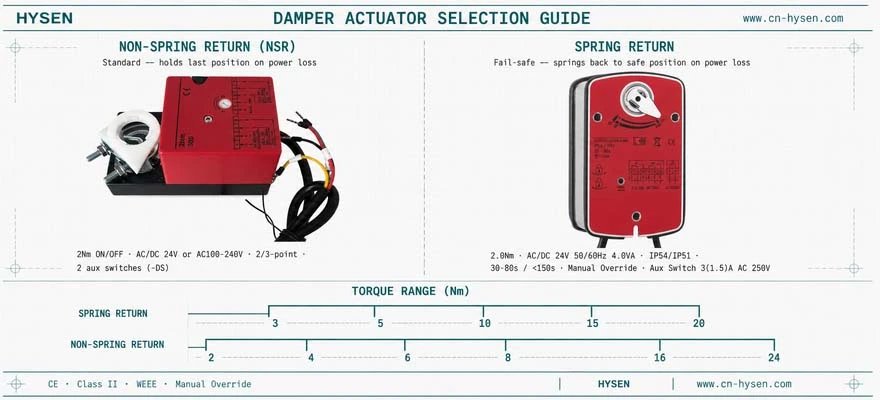
It's the question every HVAC designer and contractor asks at some point: how much torque should my damper actuator have?
Pick too little and the actuator stalls, hums, wears out early - or simply can't move the damper at all. Pick too much and you're paying for capability you'll never use, and often mounting a heavier, clumsier unit than necessary.
Torque selection isn't guesswork. It comes down to a handful of measurable factors - and once you know how to read them, you can size an actuator confidently on any project.
1. What "Torque" Means Here
Torque is the rotational force the actuator delivers to turn the damper shaft and move the blades. It's measured in newton-metres (Nm) - and sometimes in-lb or kgf·cm on older spec sheets.
Think of it simply: the actuator must overcome everything that resists the damper's movement - blade weight, air pressure, bearing friction, seals. The torque rating is how much force it can consistently supply to do that.
2. What Determines How Much Torque a Damper Needs
The same damper can need very different torque depending on its installation and condition. These are the factors that matter:
| Factor | Effect on torque demand |
|---|---|
| Damper size / blade area | Larger dampers = more surface area = more air load and blade weight |
| Number of blades | Multi-blade dampers spread the load, but need a linked drive train with its own friction |
| Blade arrangement | Opposed-blade dampers generally need more torque than parallel-blade at the same size |
| Air velocity & pressure drop | Higher duct velocity and static pressure push harder on the blades |
| Seals & gaskets | Weather seals, edge seals and gaskets add friction that increases over time |
| Bearing condition | Fresh, lubricated bearings turn easily; aged or dirty bearings fight back |
| Temperature & aging | Dust buildup and thermal effects gradually raise the load through the damper's life |
| Installation orientation | Vertical or awkward mounting can add asymmetric loading |
3. A Practical Rule of Thumb
For standard HVAC dampers at normal duct velocities, this starting point covers most projects:
| Damper size (approx.) | Recommended actuator torque |
|---|---|
| Up to ~0.25 m² (small single-blade) | 2–5 Nm |
| ~0.25 – 0.6 m² | 5 Nm |
| ~0.6 – 1.2 m² | 10–20 Nm |
| ~1.2 – 2.5 m² (multi-blade) | 20–40 Nm |
| Above 2.5 m² | 40 Nm and up, or split into multiple actuators |
4. How to Size an Actuator, Step by Step
Get the damper data - exact blade area, blade count, blade arrangement, and the manufacturer's torque requirements
Check the operating conditions - duct velocity, static pressure, temperature range, and any weather exposure
Find the base torque from the damper's torque chart at your conditions
Apply a safety factor - multiply by 1.5–2× to cover seal aging, dust, and installation variations
Account for spring return - if the actuator is spring return (fail-safe), select one or two sizes up, because the motor must also overcome the spring
Confirm the supply - check the voltage (e.g. 24 V AC/DC) and control signal match the actuator you're specifying
Verify the actuator's torque curve - rated torque is quoted at a reference temperature; output derates at elevated temperatures
5. Why the Safety Factor Matters So Much
A damper that needs 4 Nm in the showroom can easily need 6–8 Nm after a year of dust, a seized bearing, or a tight gasket. The actuator that "just fits" today is the one that stalls next season.
Sizing with margin is cheap insurance:
1.5× - clean, indoor, well-maintained installations
2× - outdoor, dusty, high-velocity, or long-life-expectancy installations
When in doubt, take the larger option - an oversized actuator runs comfortably within its rating and lasts longer; an undersized one fails early and takes the whole zone's comfort down with it.
6. Spring Return Changes the Math
This is the trap that catches most people.
A spring return actuator doesn't just move the damper - it moves the damper against its own return spring. The effective torque needed while operating is therefore the damper load plus the spring preload, which is why:
Spring return versions are typically rated one or two torque classes above the non-spring equivalent for the same damper
The fail-safe operation itself (spring pushing the damper home) also needs the spring to overcome the damper's full load - so the spring must be matched to the damper too
If you swap a non-spring actuator for a spring-return one at the same nominal size, expect it to struggle. Re-run the calculation with the spring factored in.
7. Under-Sizing vs. Over-Sizing
| Under-sized | Over-sized | |
|---|---|---|
| Movement | Stalls, slow, or won't close fully | Smooth, no strain |
| Noise | Humming, chattering | Quiet |
| Lifespan | Short - motor constantly overloaded | Long - runs well within limits |
| Cost | Cheap to buy, expensive to replace | Slightly higher upfront |
| Risk | Damper stuck mid-position in an emergency | Minimal, mostly cost |
8. Common Misconceptions
"Bigger damper = bigger actuator, proportionally." - Not linear. Blade count, arrangement and velocity matter as much as area.
"I can just look at the duct diameter." - Duct size is a weak proxy. Two identical-size dampers from different manufacturers can need very different torque.
"More torque always costs more to run." - Actuators draw power based on load and movement, not peak rating. A comfortable margin doesn't mean higher running cost.
"It worked on the last job, so it'll work here." - Different damper, different velocity, different seals. Always re-check the conditions.
9. The Short Version
Calculate from the damper's torque chart, at your real operating conditions
Multiply by a 1.5–2× safety factor for real-world aging
Add spring-return demand where applicable
Verify voltage and control signal match your system
When unsure, size up - it's the cheap direction to err
Need Help Picking the Right Torque?
Getting the torque right is the difference between an actuator that runs for years and one that fails in the first season. Our damper actuator range covers 2–40 Nm and above, in spring return and non-spring return versions, with the voltage and control-signal options your system needs. [Contact us] with your damper size and conditions - we'll help you confirm the right torque and the right actuator for the job.